Assurestor Partners with Zadara

Assurestor Partners with Zadara to Deliver Secure, Agentless Cloud Backup for zCompute 

As organisations continue to embrace cloud infrastructure, protecting critical workloads has become just as important as deploying them. Assurestor is pleased to announce its partnership with Zadara, bringing Backup2Cloud to Zadara zCompute customers as a secure, agentless backup and recovery solution designed specifically for modern cloud environments.  

Extending Data Protection Beyond Snapshots 

While Zadara’s native snapshot capabilities provide important protection within the platform, many organisations require an additional layer of resilience that remains independent of the production environment. Backup2Cloud delivers exactly that by creating encrypted, off-platform copies of data that remain accessible even in the event of platform-level incidents, cyber-attacks or data corruption.  

The solution operates independently of Zadara snapshots and hypervisor integrations, giving customers confidence that their backup strategy is not tied to a single technology layer. This complementary approach helps strengthen overall business continuity and disaster recovery capabilities. 

Agentless Backup Designed for Cloud Simplicity 

At the heart of the service is Backup2Cloud’s agentless architecture. A single DS-Client virtual appliance is deployed within a customer’s Zadara Virtual Private Cloud (VPC) using a marketplace template and can protect multiple Windows and Linux instances simultaneously. No backup agents need to be installed, patched or maintained on production systems.  

Using native operating system and application APIs, Backup2Cloud provides: 

  • Application-consistent backups for databases, mail systems and file services. 
  • Unified protection for Windows and Linux workloads. 
  • Rapid onboarding of new instances without additional deployment steps. 
  • Reduced operational overhead and complexity.  
  • For DevOps and infrastructure teams, this means backup can be provisioned alongside new cloud workloads as part of standard deployment workflows, rather than as an afterthought.  

Security Built into Every Layer 

Cyber threats continue to evolve, and backup platforms must provide more than simple data retention. Backup2Cloud incorporates multiple security controls designed to protect both data and recovery operations.  

Key security features include: 

  • AES-256 encryption applied before data leaves the customer’s VPC. 
  • TLS 1.3 encryption for all data in transit. 
  • Zero-knowledge encryption architecture, ensuring encryption keys remain under customer control. 
  • Multi-factor authentication for management and recovery operations. 
  • Role-based access controls supporting least-privilege administration. 
  • Anomaly detection to identify potential ransomware activity.  

This layered approach helps organisations strengthen their cyber resilience while maintaining control over sensitive information.  

Enhanced Ransomware Protection with Covert Protect 

One of the most innovative capabilities available through the partnership is Covert Protect, an optional storage-layer air-gap technology. Unlike traditional backup repositories that may still be visible to attackers, Covert Protect creates a hidden copy of the complete backup vault beneath the application and operating system layer.  

Because this copy operates below the software stack it cannot be discovered, modified or deleted by ransomware or malicious actors who gain access to backup systems. The result is an additional recovery option that remains available when other backup copies have been compromised.  

Supporting Compliance and Data Sovereignty 

For organisations operating in regulated industries, maintaining data sovereignty and compliance is critical. Backup2Cloud addresses these requirements through regional DS-System deployments located in the UK, EU and US, allowing customers to select where their backup data is stored.  

This regional approach supports GDPR and UK GDPR requirements while ensuring organisations retain control over data residency. Combined with Assurestor’s ISO-certified management systems and security-focused approach, customers can implement backup strategies aligned with both operational and regulatory requirements.  

A Powerful Partnership for Modern Cloud Workloads 

The partnership between Assurestor and Zadara brings together flexible cloud infrastructure and enterprise-grade data protection. Zadara customers can now deploy backup services directly from the marketplace, protect workloads without agents and benefit from advanced security features including malware scanning, anomaly detection, encrypted off-platform storage and optional air-gapped recovery.  

As businesses continue to prioritise cyber resilience, compliance and operational simplicity, Backup2Cloud for Zadara zCompute provides a compelling solution that helps organisations protect their most valuable asset, data, without adding complexity to cloud operations.  

About Assurestor 

Assurestor is a UK-headquartered provider focused on cloud backup, disaster recovery and cyber resilience solutions. With decades of data protection expertise, multiple ISO certifications and a commitment to delivering secure, reliable recovery services, Assurestor helps organisations and channel partners safeguard business-critical systems and data. Find our more:  Assurestor – Zadara

AI in the Workplace: An Honest View from the Small End of the Market

AI is the most talked about thing in business right now. So here is what it actually looks like from where I sit.

I want to be upfront before I go any further.

Assurestor is an SMB. We are a small, focused team and everything I am about to say comes from that vantage point. I have limited experience of how large SME and Enterprise organisations are approaching AI, and I have no doubt they are using it very differently to us, with different pressures, different scale and different goals.

So treat this as a personal observation, not a definitive guide. It is simply how AI looks from my chair, running a smaller business in a competitive market.

The story the headlines are telling

If you only read the press, you would be forgiven for thinking AI has one purpose: to cut costs.

And, in the coverage I see, cutting costs almost always translates to one thing. Cutting people.

Story after story frames AI as a way to shrink the wage bill, thin out teams and do more with fewer staff. For a large organisation carrying thousands of roles, I can see how that maths becomes tempting and how the boardroom conversation quickly turns to headcount.

I am not going to pretend I understand the full picture inside those businesses because I do not. But I do notice that the loudest version of the AI story is the one about people losing their jobs.

That is not the story I recognise.

What AI looks like for an SMB

For Assurestor, and I suspect for a lot of smaller businesses, AI is genuinely exciting. Not because it lets us get rid of people but because it lets our people do more.

When you run a small team you feel every gap. There is always more work than there are hours and more ideas than there are hands. AI changes that equation.

Used well, it becomes a tool that:

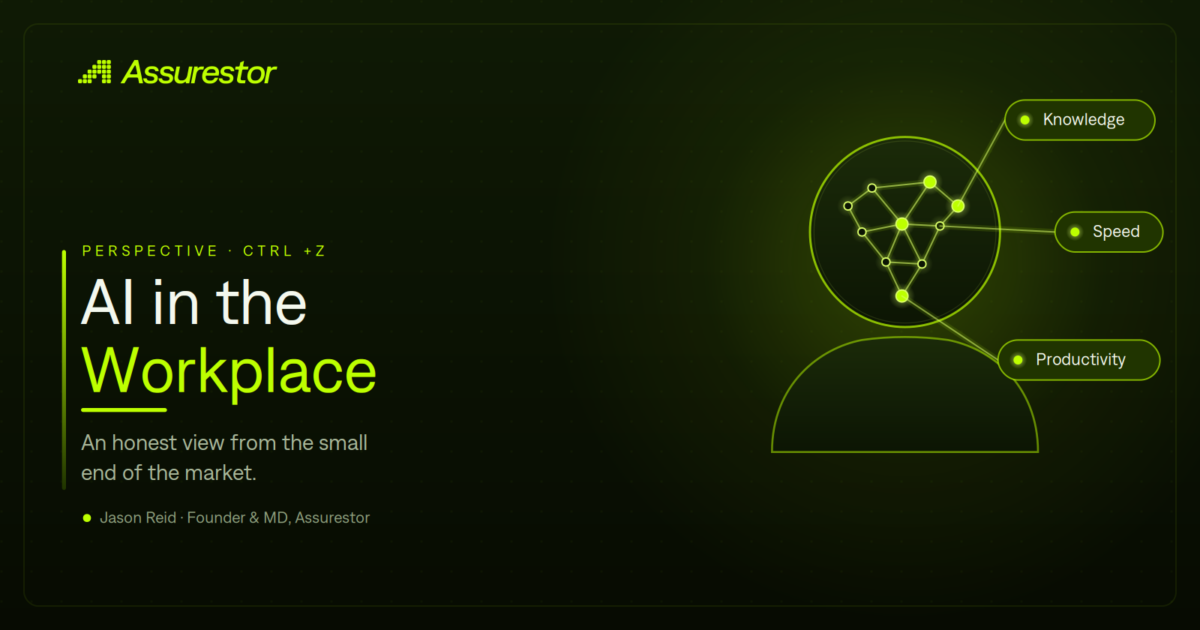
  • Extends the knowledge of the team, so a small group can operate with the depth of a much larger one.
  • Speeds up delivery, turning things that used to take days into things that take hours.
  • Lifts productivity, so the people you already have can focus on the work that actually needs a human.
  • Lets a small business punch well above its weight.

That last point is the one I keep coming back to.

For years, competing with larger organisations meant one thing: getting bigger. More people, more overhead, more cost, more risk. Growth for the sake of keeping up.

AI offers a different path. It lets a smaller, sharper team compete with much larger players, without the stress and expense of having to scale up just to stay in the game.

That is not a threat. That is an opportunity.

Being honest about the downsides

I am not blind to the concerns and it would be dishonest to write this without naming them.

The realistic risks, as I see them, are:

  • Jobs will change and some will go. Certain roles that exist today may not exist in a few years. Pretending otherwise helps no one.
  • Over-reliance is a real trap. AI is confident even when it is wrong, and a small team without the right checks can be caught out.
  • Skills can atrophy. If people stop thinking and start copying, you lose the very judgement that made them valuable.
  • The hype runs ahead of the reality. Not every problem needs AI and chasing it for its own sake wastes time and money.

None of that is a reason to avoid it. It is a reason to be deliberate about how you use it.

The bit the headlines miss

Yes, some roles will disappear. That is genuinely hard and I do not want to be glib about the human cost of it.

But every shift like this has created new roles as fast as it retired old ones. I firmly believe new skills, new responsibilities and new careers will emerge from this one too, many of which we cannot even name yet.

That is where the real opportunity sits.

For business leaders, the opportunity is to build teams that are smaller, more capable and more resilient, rather than simply bigger.

For anyone starting out, particularly anyone looking at a career in IT, my advice is simple.

Do not ignore AI. Do not be fearful of it.

The people who treat it as a threat and keep their distance will be the ones who struggle. The people who lean in, learn it and make it part of how they work will be the ones who get ahead.

Final thought

I do not claim to have all the answers, and I certainly cannot speak for how the larger end of the market will play this out.

But from where I sit, running a small business in a fast-moving industry, the conclusion is clear.

AI is not the thing that replaces your team. It is the thing that makes a good team unstoppable.

Those who embrace it will succeed. I am certain of that much.

And for a smaller business that has spent years working out how to compete with organisations many times its size, this is one of the most exciting shifts I have seen in my career.