AI in the Workplace: An Honest View from the Small End of the Market

AI is the most talked about thing in business right now. So here is what it actually looks like from where I sit.
I want to be upfront before I go any further.
Assurestor is an SMB. We are a small, focused team and everything I am about to say comes from that vantage point. I have limited experience of how large SME and Enterprise organisations are approaching AI, and I have no doubt they are using it very differently to us, with different pressures, different scale and different goals.
So treat this as a personal observation, not a definitive guide. It is simply how AI looks from my chair, running a smaller business in a competitive market.
The story the headlines are telling
If you only read the press, you would be forgiven for thinking AI has one purpose: to cut costs.
And, in the coverage I see, cutting costs almost always translates to one thing. Cutting people.
Story after story frames AI as a way to shrink the wage bill, thin out teams and do more with fewer staff. For a large organisation carrying thousands of roles, I can see how that maths becomes tempting and how the boardroom conversation quickly turns to headcount.
I am not going to pretend I understand the full picture inside those businesses because I do not. But I do notice that the loudest version of the AI story is the one about people losing their jobs.
That is not the story I recognise.
What AI looks like for an SMB
For Assurestor, and I suspect for a lot of smaller businesses, AI is genuinely exciting. Not because it lets us get rid of people but because it lets our people do more.
When you run a small team you feel every gap. There is always more work than there are hours and more ideas than there are hands. AI changes that equation.
Used well, it becomes a tool that:
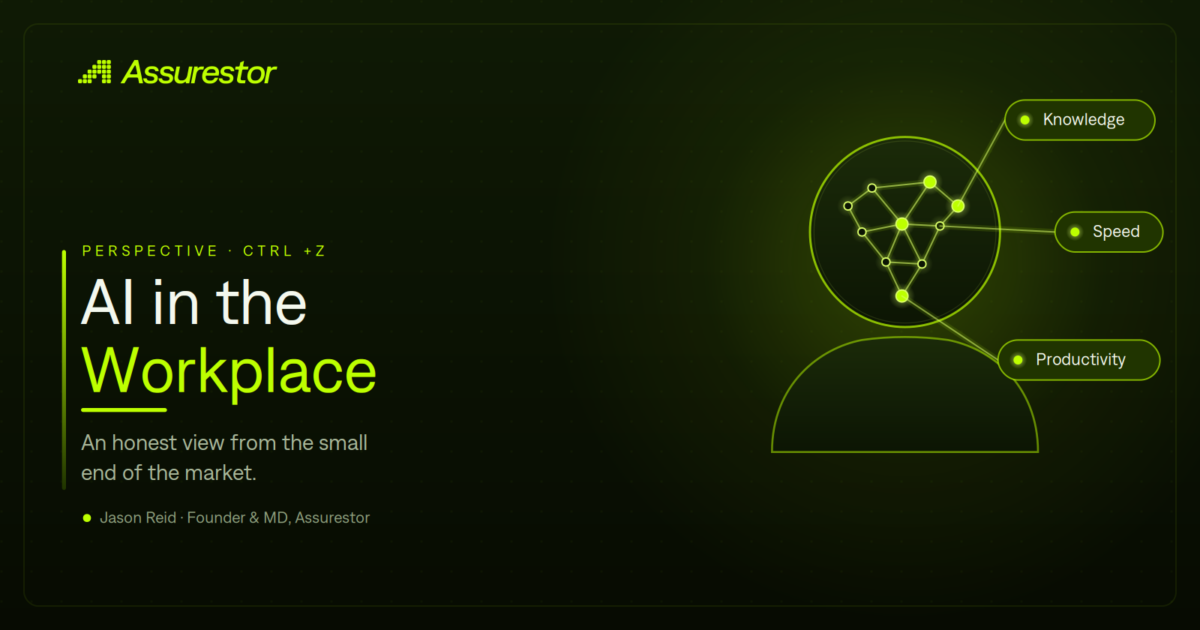
- Extends the knowledge of the team, so a small group can operate with the depth of a much larger one.
- Speeds up delivery, turning things that used to take days into things that take hours.
- Lifts productivity, so the people you already have can focus on the work that actually needs a human.
- Lets a small business punch well above its weight.
That last point is the one I keep coming back to.
For years, competing with larger organisations meant one thing: getting bigger. More people, more overhead, more cost, more risk. Growth for the sake of keeping up.
AI offers a different path. It lets a smaller, sharper team compete with much larger players, without the stress and expense of having to scale up just to stay in the game.
That is not a threat. That is an opportunity.
Being honest about the downsides
I am not blind to the concerns and it would be dishonest to write this without naming them.
The realistic risks, as I see them, are:
- Jobs will change and some will go. Certain roles that exist today may not exist in a few years. Pretending otherwise helps no one.
- Over-reliance is a real trap. AI is confident even when it is wrong, and a small team without the right checks can be caught out.
- Skills can atrophy. If people stop thinking and start copying, you lose the very judgement that made them valuable.
- The hype runs ahead of the reality. Not every problem needs AI and chasing it for its own sake wastes time and money.
None of that is a reason to avoid it. It is a reason to be deliberate about how you use it.
The bit the headlines miss
Yes, some roles will disappear. That is genuinely hard and I do not want to be glib about the human cost of it.
But every shift like this has created new roles as fast as it retired old ones. I firmly believe new skills, new responsibilities and new careers will emerge from this one too, many of which we cannot even name yet.
That is where the real opportunity sits.
For business leaders, the opportunity is to build teams that are smaller, more capable and more resilient, rather than simply bigger.
For anyone starting out, particularly anyone looking at a career in IT, my advice is simple.
Do not ignore AI. Do not be fearful of it.
The people who treat it as a threat and keep their distance will be the ones who struggle. The people who lean in, learn it and make it part of how they work will be the ones who get ahead.
Final thought
I do not claim to have all the answers, and I certainly cannot speak for how the larger end of the market will play this out.
But from where I sit, running a small business in a fast-moving industry, the conclusion is clear.
AI is not the thing that replaces your team. It is the thing that makes a good team unstoppable.
Those who embrace it will succeed. I am certain of that much.
And for a smaller business that has spent years working out how to compete with organisations many times its size, this is one of the most exciting shifts I have seen in my career.