Vendor Lock-In Is No Longer a Risk. It’s a Reality MSPs Must Design Around

The industry has changed. The way we architect data resilience must change with it.

Over the past few years, something fundamental has shifted in the infrastructure and data resilience market.

Vendor lock-in has moved from being a theoretical risk buried in strategy documents to something that is actively shaping real-world decisions. MSPs, resellers and end-user organisations are no longer just aware of it, they are designing around it.

This change has not happened by accident. It has been driven by a combination of market consolidation, evolving vendor strategies and a growing recognition that flexibility is now critical to long-term success.

The question is no longer whether vendor lock-in is a risk.

The question is what you are doing about it.

The Wake-Up Call the Industry Needed

For many in the channel, the turning point was the transformation of VMware following its acquisition by Broadcom.

In a short space of time, we have seen fundamental changes:

  • A shift away from perpetual licensing towards subscription-only models.
  • A significant restructuring of partner programmes, reducing the number of authorised partners.
  • The removal of routes to market that MSPs had relied on for years.
  • Pricing and licensing changes that introduced uncertainty across the ecosystem.

These changes have had a ripple effect across the market.

Partners that had built entire service offerings around a single platform suddenly found themselves exposed. End customers began asking more challenging questions about portability, cost control and long-term risk.

And, importantly, confidence in single-vendor strategies started to erode.

This is not a criticism of any one vendor. It is a reflection of a broader industry shift.

We are seeing similar consolidation and tighter ecosystem alignment across major players, including HPE, Zerto and Veeam. These moves create powerful platforms, but they also reinforce a clear message.

Vendors want deeper commitment.

Customers want more choice.

Why the Market Is Becoming More Cautious

In conversations with partners today, there is a clear and consistent shift in mindset.

Organisations are moving:

  • From best product to best strategy
  • From vendor alignment to vendor independence
  • From standardisation to adaptability

The reason is simple.

Vendor lock-in is not just a technical issue. It is a commercial and operational constraint.

It impacts:

  • Pricing leverage
  • Speed of innovation
  • Ability to respond to change
  • Customer retention

We are now seeing multi-platform and hybrid strategies become the norm, not the exception. Organisations want the ability to select the right platform for the right workload and retain the freedom to change when needed.

Flexibility is no longer a nice-to-have.

It is becoming a baseline expectation.

The Problem with a Single-Stack Approach

There was a time when building around a single vendor made sense.

It simplified operations. It aligned skills. It reduced integration effort.

But that model depends on one assumption: Stability.

When vendor programmes, pricing, or product direction change, a single-stack strategy becomes a single point of failure.

Today, no vendor can realistically be the best across every aspect of data resilience.

Backup, disaster recovery, SaaS protection, cyber resilience, archive and workload mobility. Each of these areas evolves at a different pace and different platforms lead in different categories.

Trying to force every use case onto one platform inevitably leads to compromise.

A Different Model, Built for Today’s Reality

At Assurestor, we made a conscious decision not to build around a single vendor.

Instead, we built a multi-vendor data resilience ecosystem, underpinned by six strategic technology stacks.

This is not about offering more choice for the sake of it.

It is about giving our partners the ability to deliver the right outcome for every customer, without being constrained by the limitations of a single platform.

Crucially, we combine this with a single specialist Cloud Service Provider model.

That means:

  • One commercial relationship
  • One support experience
  • One onboarding journey

But behind it sits a portfolio of technologies that can be blended to meet specific requirements.

What This Means for Assurestor Partners

This approach delivers practical, tangible benefits for MSPs and resellers.

The ability to match platform to use case

Partners can design solutions around customer needs, rather than forcing customers into a predefined stack.

Reduced reliance on any single vendor

If one platform changes, your entire proposition is not at risk.

Stronger commercial positioning

Flexibility creates negotiating power and allows partners to stay competitive.

A true data resilience strategy

By combining technologies, partners can deliver end-to-end protection across hybrid, cloud and SaaS environments.

This is not about complexity.

It is about control.

The Role of a Specialist CSP

Multi-vendor strategies can introduce operational overhead if not managed correctly.

That is where the role of a specialist CSP becomes critical.

At Assurestor, we remove that complexity by acting as a single point of engagement, while providing access to multiple enterprise-grade platforms.

The result is simple.

Choice without fragmentation.
Flexibility without operational burden.
Confidence without compromise.

What Happens Next

The direction of travel in the market is clear.

Customers are becoming more informed.
They are asking more questions.
They are thinking longer term.

And they are placing increasing value on partners who can offer independence, not just expertise.

The next wave of disruption in our industry is not a question of if. It is when.

The partners who are prepared for that change will be the ones who have already designed it into their strategy.

Final Thought

Vendor lock-in is no longer a theoretical risk.

It is a present-day factor influencing how platforms are selected, how services are delivered and how customer relationships are maintained.

The most successful MSPs and resellers over the next five years will not be defined by the vendor they chose.

They will be defined by the flexibility they built into their business.

Ready to Rethink Your Data Resilience Strategy?

Assurestor is enabling a new generation of channel partners to deliver data resilience without constraint.

If you want to explore how a multi-vendor approach can strengthen your offering and give you greater control, we are ready to help.

Speak to the Assurestor team to see how our six-platform ecosystem can support your next customer opportunity.

Identity Has Always Been Critical But Now It’s a Primary Risk

Identity is now the control point for everything …

Identity has always played a central role in IT environments. From Active Directory through to modern identity providers, access control has long been a core part of how organisations manage systems and users.
What has changed is not the existence of identity. It is the role it now plays and the level of risk attached to it.

Across all IT environments, identity sits at the centre of access. Users connect to SaaS platforms like Microsoft 365 and Salesforce, cloud and on-premises infrastructure, and business-critical applications, all through identity.

That means identity is no longer just a layer within the architecture. It is the control point for it.

If identity is compromised, attackers do not need to bypass infrastructure controls. They can simply log in. And when they do, they do not just gain access to live systems. They gain access to the tools and data organisations rely on to recover. Backup infrastructure, recovery points, response capabilities. All of it becomes a target.

That is why immutability and covert protection, core capabilities within Assurestor’s NG platform, are so important. Ensuring backup data cannot be altered or deleted, regardless of who has access, removes one of the most critical leverage points an attacker can exploit.

The attack surface has changed …

For a long time, protection strategies focused on infrastructure. Servers, storage, networks. That made sense because that is where the risk lived.

But environments have changed, and so has the way attacks happen. Today, most successful attacks do not break through walls. They walk through the door using stolen or compromised credentials. They target identity platforms directly. They escalate privileges quietly, moving through systems without triggering the alerts that traditional infrastructure controls were built to catch.

This changes what organisations need to think about. It is no longer just about keeping attackers out. It is about what happens when someone is already inside, using access that looks completely legitimate.

The recoverability gap …

Identity resilience is the ability to back up, recover and restore identity configurations, access policies and user data quickly after a breach or outage. Yet one of the most common conversations we have with organisations is around a belief that because identity sits within a major SaaS platform, it is automatically protected. It is an understandable assumption, but it is one that leaves a lot of organisations exposed.

According to Gartner’s 2024 IAM Leadership Survey, 54% of organisations have seen an increase in identity-related breaches, with one in three experiencing business interruptions, financial loss or regulatory penalties as a result. The gap between assumption and reality is not just a security problem. It is a business risk.

Most identity platforms are built to handle authentication, availability and access management. What they are not built to do is provide independent backup of identity data, recovery of configurations, rollback of changes, or protection against actions that are accidental or deliberate.

That creates a gap. Not in access control, but in recoverability. An identity platform being available is not the same as it being recoverable. Configurations, policies, roles and access rights can be changed, corrupted or deleted. Without independent protection, restoring them to a known good state is not straightforward. In a real incident, that gap can significantly extend recovery time and the overall impact on the business.

“Assurestor’s latest Next Generation (NG) platforms include broad support to protect the key identity providers used by modern organisations, including Microsoft Entra ID, Okta Identity Cloud and AWS IAM.”
Jason Reid, Managing Director, Assurestor

Identity is now a resilience issue …

Identity has traditionally sat within the security function. But in practice, it now touches far more than that.

When identity is compromised, the consequences spread quickly. Access to SaaS platforms can be disrupted, data can be altered or deleted, and privileges can be escalated across multiple systems. In serious cases, entire environments can be affected before the incident is even detected.

At that point, the challenge is not prevention. It is recovery. And recovery requires more than good security tooling. It requires the ability to restore identity to a known good state, quickly and with precision. That is why identity now sits at the intersection of security, data protection and disaster recovery, and why organisations that treat it as a resilience issue are in a much stronger position when something goes wrong.

“Identity is no longer just a security concern, it is a business resilience one. Organisations that protect and recover their identity systems with the same rigor as their critical data are the ones that stay operational when things go wrong.”
Andy Fernandez, General Manager of AI and Cyber, HYCU

What organisations should be thinking about …

Protecting identity properly means treating it as part of a broader resilience strategy, not a separate workstream. That means ensuring identity data and configurations are protected independently, that recovery is fast and granular, and that identity is included in wider backup and recovery planning alongside SaaS, cloud and infrastructure.

The organisations getting this right are not necessarily the ones with the most tools. They are the ones that have closed the gaps the obvious tools leave behind. Find out how Assurestor’s NG platforms can help close those gaps.

Join the conversation …

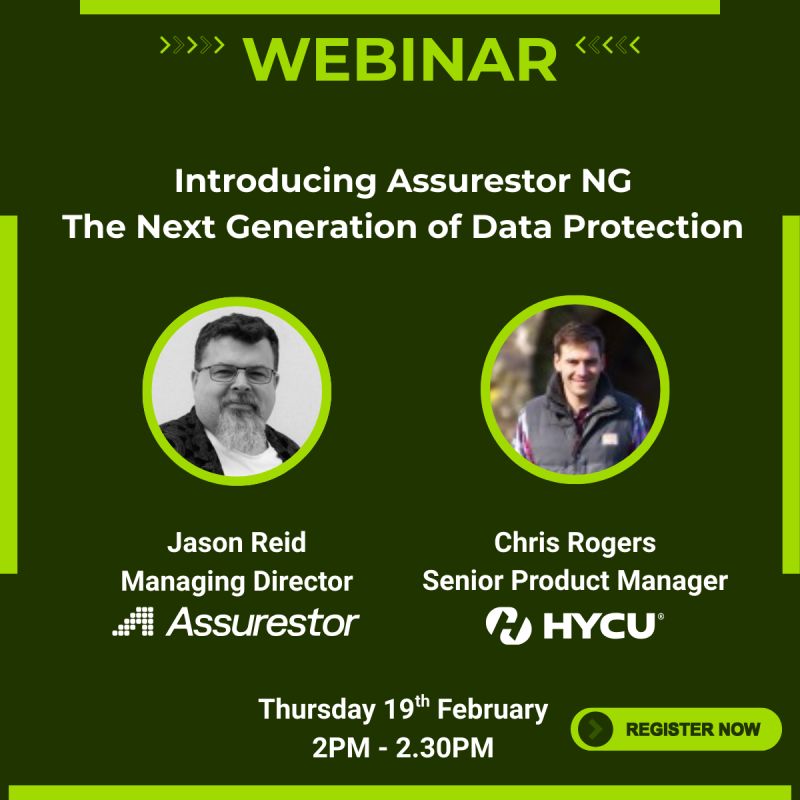
We will be exploring identity risk and modern data protection in more detail in our upcoming session with HYCU.

Webinar: Identity and Modern Data Protection
7th May – 3.00 pm
We will be covering how identity risk is evolving, where traditional approaches fall short, and what organisations and partners should be thinking about next.

Final thought …

Identity is not a new concept. But the role it plays, and the impact it can have when things go wrong, has changed significantly.
Protecting it properly is no longer optional. It is part of protecting everything else.

Introducing Assurestor NG: The Next Generation of Data Protection

The data protection landscape is changing faster than ever. SaaS sprawl, cloud modernisation and the ongoing shift away from legacy virtualisation platforms are forcing partners to rethink how they protect customer data, and how they monetise it.

That is why we recently launched Assurestor NG, our next generation data protection platforms, built in partnership with HYCU and designed specifically for the way modern IT environments actually work today.

In the launch webinar, we introduced what Assurestor NG is, why we built it and how it opens up new opportunities for partners. Here are the key takeaways.

Why Data Protection Needed a Rethink
Three major industry shifts are reshaping where partners win.

1. The SaaS Explosion
SaaS backup is no longer just about Microsoft 365. Organisations are now running hundreds of SaaS applications, many of them mission critical. Yet protection remains inconsistent or missing entirely.

The result is increased cyber risk, data loss and compliance exposure, but also a huge and largely untapped revenue opportunity for partners.

2. Virtualisation Disruption
Recent changes in the virtualisation market have triggered widespread platform reassessment. Customers are renewing reluctantly, migrating to alternative hypervisors or modernising workloads into cloud or SaaS.

Each path creates complexity and demand for flexible, purpose built data protection.

3. Cloud Modernisation
As workloads move into public cloud and cloud native services, traditional backup models break down. Partners still need account control, predictable recurring revenue and a way to protect and monetise new cloud workloads properly.

These shifts do not happen in isolation. Many customers are dealing with all three at once.

What Is Assurestor NG?
Assurestor NG is delivered as two next generation platform services, both fully managed and supported by Assurestor and powered by HYCU technology.

Backup2Cloud NG
Built on HYCU Hybrid Cloud Edition, this platform focuses on protecting infrastructure workloads across VMware, Nutanix, Hyper V, Azure Local and public cloud environments.

It goes far beyond basic backup, delivering:
✔ Backup and recovery
✔ Disaster recovery
✔ Malware scanning and cyber resilience
✔ Mobility and workload migration
✔ Long term retention and archive
✔ Application discovery and compliance insight

All delivered as a fully inclusive service covering software, compute, storage and support.

SaaS2Cloud NG
Powered by HYCU R Cloud, this platform protects data across more than 75 SaaS and cloud services today, with coverage expanding continuously.

This goes far beyond Microsoft 365, extending to identity platforms, developer tools, collaboration services and other SaaS applications that often hold an organisation’s most valuable data.

Built for Partners, Not Complexity
Assurestor NG follows the same principles that Assurestor has been built on for 14 years.
✔ Wholesale consumption model, start small and scale fast
✔ Simple SKU based pricing with no smoke and mirrors
✔ Secure by design, with MFA, credential management and compliance built in
✔ Competitive positioning without a premium price penalty
✔ Fully managed by Assurestor so partners can focus on selling, not running platforms

Our partners do not need to worry about infrastructure, upgrades or platform operations. We handle that so they can focus on customers and margin.

Why SaaS Protection Is the Next Revenue Engine
The numbers tell the story.
✔ The average organisation runs 139 SaaS applications.
✔ 65 percent experienced a SaaS related breach in the past 12 months.
✔ 87 percent admit at least one SaaS application is inadequately protected.
✔ The average cost of a SaaS cyber incident is 2.3 million dollars.

SaaS data is everywhere and often nowhere near as protected as customers think.

Assurestor NG enables partners to protect infrastructure, identity and intellectual property across on premises, cloud and SaaS environments through a single ecosystem.

Why HYCU?
HYCU brings deep native integration across modern platforms, industry leading coverage for Nutanix and cloud workloads, SaaS first data protection at global scale and an industry leading Net Promoter Score of 91.

They were built for modern environments and that alignment made them the right partner for Assurestor NG.

HYCU has also been recognised as a leader in SaaS data protection, reinforcing the strategic direction behind Assurestor’s next generation platforms.

The Bottom Line
The modern data estate no longer stops at infrastructure, and neither can data protection.

With Assurestor NG, partners can protect more than 125 workload environments, differentiate in the fastest growing segments of IT, open new recurring revenue streams, retain account control as customers modernise and move faster with confidence.

The world of IT is evolving at pace. Assurestor NG is how we help our partners keep up and stay ahead.

Assurestor Announces Next-Generation Data Protection Services Powered by HYCU, Delivering Unmatched Coverage Across the Hybrid Enterprise

New Cloud and SaaS Data Protection Services Provide Partners with Powerful Backup and Disaster Recovery Options to Protect Data Regardless of Location

London, Feb. 5, 2026 – Assurestor, the total protection and data recovery company, today unveiled its next-generation data protection services, powered by industry-leading HYCU R-Cloud technology. Designed to meet the evolving needs of modern IT environments, these newest services provide comprehensive backup and disaster recovery across an exceptionally wide range of data sources, whether on-prem, in hybrid infrastructures, or across multi-cloud environments.

“Our partners need flexibility and depth of protection in order to protect and recover mission-critical data across their modern IT environments,” said Jason Reid, Managing Director at Assurestor. “Backup2Cloud NG and SaaS2Cloud NG help us expand our mission to bring the most comprehensive, yet easy-to-use, data protection solutions to our MSP and reseller partners. These new solutions represent a significant step forward for our portfolio and reinforces our commitment to deliver simple, powerful, and scalable data protection services so our partners can protect their customers’ data wherever it resides, across SaaS, Cloud, virtual, and physical environments.”

As a channel-only organisation, Assurestor is dedicated to equipping MSPs and resellers in the UK, and globally, with best-of-breed technologies that enable them to protect and manage their customers’ critical data with confidence.

The newly introduced Backup2Cloud NG and SaaS2Cloud NG platforms deliver advanced data protection capabilities that span the full spectrum of enterprise workloads.

Protect All Your Critical Data, Wherever It Lives

Leveraging HYCU R-Cloud’s modern, SaaS-native architecture, Assurestor’s next-generation offerings can safeguard:

✔ Cloud-native SaaS applications: including leading productivity and collaboration platforms used by organisations worldwide. HYCU has built extensive connectors to protect data hosted in SaaS environments such as Microsoft 365, Google Workspace, iManage Cloud, Salesforce, service management systems and many more applications.

✔ Virtual machines and hypervisor environments: comprehensive support for virtual workloads running on Nutanix, VMware, Hyper-V, Xen Server and other virtual infrastructures.

✔ Public, private and hybrid cloud workloads: unified protection for cloud instances and services across AWS, Microsoft Azure, Google Cloud and other major cloud providers, without compromising visibility or control.

✔ Physical servers and endpoints: robust backup for traditional physical systems, ensuring legacy and modern workloads are protected under one platform.

✔ Databases and enterprise applications: specialised support that enables backup and recovery of complex application data alongside file-level and image-level protection.

✔ On-premises infrastructure and data stores: complete coverage for in-house systems that remain critical to business continuity.

This breadth of coverage reflects HYCU’s leadership in delivering automated, scalable and secure data protection across hybrid and multi-cloud environments a capability that Assurestor now makes available to the channel ecosystem with its latest platforms.

By combining Assurestor’s channel-centric approach with HYCU’s broad source support and cloud-native engineering, these next-generation services set a new standard in data protection for modern businesses.

For more information on Assurestor, visit www.assurestor.com and connect with us on LinkedIn.

About Assurestor
Assurestor is a UK-based, channel-only backup and disaster recovery service provider focused on enabling MSPs and IT resellers to deliver enterprise-grade data protection services through a fully managed, service-led model.

Media Contact:
Lou Eddy
Louise.Eddy@assurestor.com

Break the Attack Loop: Why In-Line Scanning During Backup & Restore Is Now Non-Negotiable

When ransomware hits, the room splits in two.

One side is calm: they’ve backed up, tested their recovery, and know exactly what to do. The other side is staring at encrypted screens, weighing up whether to pay a criminal and hoping the decryption key actually works.

But here’s the uncomfortable truth that’s changed the game: having a backup is no longer enough. Cybercriminals have evolved. They now specifically target your backup infrastructure, and they’ve developed a particularly insidious tactic to neutralise your last line of defence before you even know an attack is coming.

The Attack Loop: How Ransomware Defeated Traditional Backup

The latest ransomware strains don’t announce their presence immediately. It may take days, weeks, sometimes months, before an attack is initiated. During that dormant period, malware is quietly embedded across your systems and, critically, backed up alongside your legitimate data.

When you finally trigger a restore to recover from the attack, you bring the malware back with you. The production environment is re-infected. The attackers win again. This is the Attack Loop, and it’s exactly why a backup alone is no longer a resilience strategy.

Cybercriminals understand the economics perfectly. A good backup means a bad payday for them. So they’ve adapted to poison the well.

Why Traditional Backup Software Falls Short

Most legacy backup tools were designed for a simpler threat landscape. They capture data, store it, and retrieve it. Security was an afterthought: an add-on, not a core function.
The problems are structural:

Backups scan at the point of backup only. If malware was dormant during the backup window, it gets archived cleanly. By the time it activates, it’s embedded in every recovery point you own.

Predictable file naming conventions. Experienced attackers know exactly what backup repositories look like on disk. Traditional tools use recognisable file structures, making it straightforward for an attacker who’s gained access to locate and delete or corrupt your backups directly.

Single-factor access to management consoles. If an attacker phishes an admin’s credentials, they can walk straight into your backup settings and quietly disable retention policies, delete repositories, or alter schedules, days or weeks before triggering the ransomware payload.

No protection against double and triple extortion. Attackers increasingly download a copy of your data before encrypting it. If your backup data isn’t encrypted at rest and in-flight, it becomes a secondary target and another lever for demanding payment.

The Modern Answer: Bidirectional In-Line Scanning

The solution isn’t just better antivirus. It’s fundamentally rethinking where and when scanning happens in the backup and recovery workflow.

Asigra Tigris is built on this principle. Rather than treating security as an external layer, it embeds protection directly into the backup and restore pipeline through what it calls a “Deep Six” security architecture.

Scan on Backup, and on Restore

Tigris performs two malware scans. The first happens during backup: every file is scanned, and any malware detected is quarantined rather than archived. But the critical innovation is the second scan, performed during the restore process.

This is what breaks the Attack Loop. When you restore data after an attack, Tigris scans again. Any ransomware that was dormant during the original backup, and therefore backed up cleanly, is caught at restore time, quarantined, and prevented from re-infecting your production environment. You restore clean data, not the infection.

Content Disarm and Reconstruction (CDR)

Modern ransomware doesn’t always look like malware. It hides inside ordinary business documents: PDFs, Office files with macros, media files. Even advanced antimalware scanning can miss deeply embedded executable objects inside these file types.

Content Disarm and Reconstruction (CDR) addresses this by deconstructing files, stripping any potentially malicious code, and rebuilding a clean, functional version. Tigris applies CDR as part of both the backup and restore process, not just at the network gateway where it’s traditionally deployed. That matters, because it only takes one file getting past your front door to start an attack.

Multiperson Approval (MPA) and Multifactor Authentication (MFA)

Credential theft is one of the most common attack vectors. If a threat actor phishes an admin’s login, they can make destructive changes to backup settings without triggering any alarms.

Tigris counters this with two layers. MFA adds a second authentication step for login and for any potentially destructive action, such as deleting backup repositories. MPA goes further, requiring multiple people to approve such actions. An attacker with one set of stolen credentials simply cannot proceed unilaterally.

Repository Obfuscation with Variable Naming

If an attacker gains access to your storage environment, knowing where your backups live is half the battle. Traditional tools use predictable, well-known file naming patterns.
Tigris uses variable repository naming, dynamically obscuring backup file identities so attackers cannot easily identify, locate, or target your recovery data, even with storage-level access.

Soft Delete: The Hidden Safety Net

Even if an attacker manages to access the backup management console and attempts to delete backup jobs, Tigris has one more layer of protection. Soft Delete gives the appearance of successful deletion; the admin console reports it’s done, but a hidden copy of the backup job is retained, recoverable only by those who know it exists.

True deletion requires a separate two-step process that isn’t visible to an attacker unfamiliar with the system.

AES-256 Encryption In-Flight and At-Rest

Double and triple extortion attacks, where attackers steal data before encrypting it and then threaten to publish it, are now standard practice. Backup data is increasingly the softer target.

Tigris protects against this with NIST FIPS 140-2, AES-256-bit encryption covering data both in transit and at rest, making backup repositories useless to attackers even if they succeed in exfiltrating them.

Agentless Architecture: Security Without the Overhead

One reason organisations sometimes underinvest in backup security is operational friction. Deploying and maintaining agents across every endpoint adds complexity, creates attack surface, and slows down updates.

Tigris deploys as a network-based, agentless architecture with no endpoint agents required. It can be deployed in Docker containers, managed through a single pane of glass, and covers operating systems, virtual machines, and databases comprehensively. Updates are smoother, administration is reduced, and the security footprint itself is minimised.

Recovery Confidence Matters as Much as Security

Security is only half the equation. When the worst happens, recovery needs to be fast and reliable.
Tigris pairs its security architecture with advanced recovery capabilities: autonomic healing that automatically repairs corrupted backups, in-memory restore validation that tests recovery before it goes live, VM replication for standby failover, and incremental-forever backup that lets you restore from any point in time. Granular recovery means you can restore an individual file or an entire data centre, on demand.

For more on how Asigra Tigris protects backup environments against modern ransomware tactics and how to get a Ready-To-Use Tigris Platform (Backup2Cloud) click below…

Business readiness for a ransomware attack

The growing threat

The threat from ransomware is growing with the sophistication of the attacks – and technical ability of the attackers – constantly challenging the security measures implemented by businesses striving to protect their systems and data in an increasingly hostile cyber environment.

It’s no longer a case of if a business is attacked, but when, and, at that point, how ready is the business to recover effectively and efficiently from such an attack? There are few second chances when the stakes are so high.

A recent Sophos survey indicated 59% of global businesses were hit by some form of ransomware. 94% of businesses indicated that the attackers had attempted to compromise their backup systems, with 57% being successful.

The time to assess the ability of a business to fully recover has never been more urgent, with a stress on the proactiveness of that preparation time. Identifying any flaws in the plan, or recovery technology deployed, are crucial tasks in a business fitness test.

Fully testing the recoverability of an organisation requires frequent testing – and this can only be carried out effectively if the testing process is non-disruptive, quick, simple and encompasses the business’ entire system and data. Crucially, the skillset and prior experience of staff charged with conducting a successful recovery needs to be factored in for a requirement so nuanced and potentially infrequent.

When the chaos and stress of a business-threatening ransomware attack is unfolding, discovering unnoticed or overlooked flaws in the recovery plan – alongside a lack of skills and experience in business recovery – is irresponsible business practice. Having the confidence to invoke an extremely well-tested and orchestrated business recovery process is critical. When security is compromised this could be the only time to thwart the attempts of cyber criminals to extort significant sums from the business, often even business-ending.

Cloud provider effectiveness

MSPs are ideally positioned to offer DRaaS and BaaS platforms that provide non-disruptive disaster recovery testing, enabling teams charged with business recovery to carry out full and frequent tests without impacting production environments. Additionally, the separation of cloud recovery systems from the production environments adds another layer of much-needed protection.

MSPs specialising in disaster recovery technologies can significantly improve the recovery of an organisation when struck by ransomware. MSPs will have the experience, exposure and expertise to advise on effective techniques and services to deploy, balancing business requirements with available budgets, keeping those achievable RTOs and RPOs realistic.

MSPs can remove many of the concerns for organisations when considering and budgeting for disaster recovery solutions, including; the capital cost of the hardware and software required; the ability to scale up or down as business needs change; the necessary skills required to maintain such a system and invoke a recovery when needed; and the ongoing maintenance costs and inevitable renewal costs.

An update to your approach

Now is the time to shift thinking within IT teams, but also the wider business, about the potential for risk and the collaborative efforts required to protect the business from what will become an undeniable set of threats.

The recommended rhythm and cadence of testing might seem unrealistic, or even unachievable with the current technology deployed within a business. That’s ok. What we strongly believe is that by setting in place a new standard – even if simply an improvement on the status quo at first – businesses can create a necessary shift in mindset towards recoverability and data usability. Setting this new operational standard will undoubtedly place the business in a better state of readiness to recover from a major issue, as and when it happens.